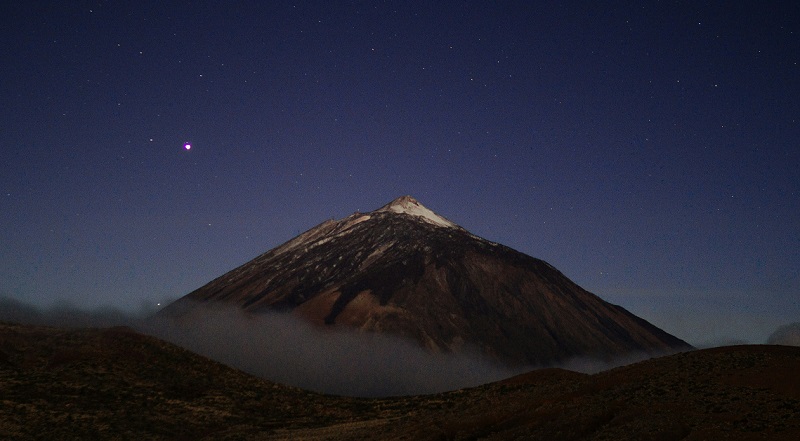
Most people who visit Tenerife spend their evenings in a beach bar, watching the last of the sunset fade over the Atlantic. That is a perfectly reasonable way to spend a night. But if you drive up into the mountains after dark, you will find something that stops people in their tracks every single time: a sky so packed with stars that it barely looks real. Tenerife is one of the finest stargazing destinations on the planet, sitting alongside Chile and Hawaii as a location where astronomers and amateurs alike come specifically to look up. This guide explains why the island’s skies are so exceptional, where to go, what to expect across different seasons, and how to decide between doing it yourself and joining a guided tour.
Contents
- Why Tenerife Is One of the World’s Best Stargazing Destinations
- The Best Stargazing Spots on the Island
- What You Can Actually See from Tenerife
- The Best Time of Year to Go Stargazing
- Guided Tours vs Doing It Yourself
- Recommended Tour Operators
- The Teide Observatory
- Getting to the National Park from South Tenerife
- Practical Tips
- Frequently Asked Questions
Why Tenerife Is One of the World’s Best Stargazing Destinations
Several factors combine to make Tenerife’s night sky genuinely exceptional, rather than merely good. The first is altitude. The heart of the island, Teide National Park, sits at over 2,000 metres above sea level. At that height you are above much of the water vapour and cloud cover that blurs the sky at lower altitudes. The air is drier, thinner, and far more transparent. On a clear night, you are not looking through the same atmosphere that sits over a beach resort.
The second factor is geography. Tenerife lies in the Atlantic Ocean, far from the industrial light pollution of mainland Europe. The Sahara is to the east, the open ocean stretches in every other direction. There are no major cities nearby to wash out the sky with orange glow. The island’s own light pollution is tightly controlled under the Ley del Cielo, the Canarian Sky Law passed in 1988, one of the first pieces of legislation anywhere in the world designed specifically to protect astronomical conditions. This law remains a global model and is the reason the skies above Teide remain as dark as they do despite millions of tourists visiting the island each year.
The third factor is the thermal inversion layer. A layer of warm air sits above the cooler air near the ocean, acting as a lid that traps cloud and moisture below. When you drive up through the clouds and emerge above them in the national park, you often find perfectly stable, dry air and a sky that is almost impossibly clear. This phenomenon is reliable enough that professional observatories were built here. The Teide Observatory, operated by the Instituto de Astrofísica de Canarias, has been running since 1964 and remains one of the most important solar and astrophysical research centres in the world.
In 2014, Teide National Park was awarded Starlight Destination certification by the Starlight Foundation, reserved for places that meet strict criteria for sky protection, dark sky quality, and sustainable astrotourism. It is one of very few places in Europe to hold this status. For visitors, it is essentially a quality guarantee: the conditions are independently verified as among the best in the world.
The Best Stargazing Spots on the Island
The further you get from the coast and the higher you climb, the better the sky becomes.
| Location | Altitude | Best For | Notes |
|---|---|---|---|
| Teide National Park, Las Cañadas | 2,000 to 2,200m | Everything. The benchmark location | Llano de Ucanca plain and cable car base station are the go-to spots. Milky Way visible to the naked eye on clear nights |
| Roques de García | ~2,100m | Astrophotography | Dramatic volcanic rock formations create a striking foreground. Most photographed stargazing location in the Canaries |
| Mirador de Chipeque | ~2,000m | Quieter alternative to the park itself | On the road up to the national park. On nights when cloud is below you, spectacular panorama of the island |
| Mirador de Masca | ~650m | Remote feel, ocean horizon views | Northwest of the island. Narrow winding road requires care at night. Views across to La Gomera silhouette |
| Güímar Valley | Variable | Avoiding tour groups | East of the island. Own nature reserve established to protect sky quality. Largely unknown to tourists |
| La Escalona | Modest | Southern visitors who cannot drive to the park | Small town set back from the south coast. Surprisingly dark skies without the full mountain drive |
What You Can Actually See from Tenerife
From Mount Teide, it is possible to see 83 of the 88 officially recognised constellations over the course of a year. On a clear, moonless night, several things will genuinely take your breath away.
For most visitors from the UK or northern Europe, this is the single most impressive sight. At home it is at best a faint smudge. Here it is a proper structure, broad and textured, with visible dark lanes and brighter star-forming regions. Summer evenings from June to September give the best views of the galactic centre.
Depending on the time of year, Saturn’s rings, Jupiter’s moons, and Mars’s surface detail are all visible through a telescope of even modest quality. The stable air at altitude means planets do not shimmer and blur the way they do from sea level.
The Perseids in August produce dozens of shooting stars per hour and coincide with warm summer nights. The Geminids in December are often the most intense shower of the year. The Quadrantids in January are another strong shower for early-year visitors. All are exceptional from Teide.
Orion becomes brilliantly clear in winter. The Pleiades star cluster, the Andromeda Galaxy, and various nebulae are all visible with binoculars or a small telescope. The zodiacal light is far more commonly visible here than anywhere in northern Europe.
The Best Time of Year to Go Stargazing
One of the genuine advantages of Tenerife over most European stargazing destinations is that the sky is good all year round. Clear nights in January and clear nights in August are both realistic, which is not something you can say about Scotland or the Alps.
| Season | Conditions | Best For | Temperature at 2,000m |
|---|---|---|---|
| Summer (Jun to Sep) | Warmer, shorter nights | Milky Way galactic core, Perseid meteor shower, most comfortable conditions | Cool but not cold |
| Autumn (Oct to Nov) | Excellent, longer nights beginning | Good all-round stargazing, fewer tour groups than summer | Cold. Bring layers |
| Winter (Dec to Feb) | Longest nights, exceptional conditions | Orion, Geminid and Quadrantid meteor showers, deep-sky objects | Can drop below zero. Proper winter coat essential |
| Spring (Mar to May) | Good and improving | Comfortable temperatures beginning to return, less crowded | Cold to cool |
A full moon dramatically reduces the number of stars you can see and all but washes out the Milky Way. Plan your visit around the new moon or when the moon is a thin crescent and sets early. Even a half moon significantly affects the experience. Check a lunar calendar before choosing your date, and pair it with a clear weather forecast for the national park specifically, which can differ from conditions on the coast.
Guided Tours vs Doing It Yourself
| Guided Tour | DIY | |
|---|---|---|
| Hire car needed? | No. Hotel pickup included with most operators | Yes. Essential |
| Cost | €35 to €103 per person depending on tour | Fuel only |
| Telescopes provided? | Yes. Professional grade | Bring your own or use binoculars |
| Expert commentary? | Yes. Certified Starlight guides | No. Use Stellarium app |
| Group size | Varies. Larger tours 40 to 50 people. Smaller eco tours 6 to 12 | Just your group |
| Experience | Structured, educational, social | Silent, personal, entirely on your own terms |
| Best for | Visitors without a hire car, families, first-timers, those who want context | Confident drivers who want solitude and full flexibility |
No permit is needed to enter Teide National Park at night. The park has no gates and is accessible around the clock. Bring warm layers, a red-light torch, a blanket, and binoculars. Download Stellarium before you go. It uses your location and points at the sky to identify stars, planets, and constellations in real time. Night mode keeps your screen red so it does not destroy your dark adaptation.
Recommended Tour Operators
Volcano Teide
| Observation Point | Cable car base station car park, 2,356 metres, km 43 of the TF-21 |
| Tour Options | Stargazing only from €35. Sunset and Stars (cable car after hours + dinner + stargazing). Full Astronomical Tour (observatory visit + stargazing) from €103 |
| Telescopes | Celestron CPC 9.25″ Schmidt-Cassegrain and Dobson Sky Watcher 30cm Newtonian |
| Transport | Hotel pickup from south and north Tenerife included |
| Languages | English, Spanish, German |
| Min Age | Children under 8 not admitted to night-time activities |
| Website | volcanoteide.com |
The Sunset and Stars tour is their most popular and can have up to 40 people in the English-language group. If a smaller, more intimate experience is the priority, consider their standard stargazing observation tour which runs in smaller groups, or compare with Teide by Night and Discover Experience below.
Teide by Night
| Approach | More personal than Volcano Teide, with smaller groups and a focus on the full evening experience |
| What’s Included | Hotel pickup, drive through volcanic landscape, sunset, dinner, telescopes with a knowledgeable guide |
| Best For | Visitors who want a smaller group than the Volcano Teide mainstream tours |
| Website | teidebynight.com |
Discover Experience
| Tour Days | Mondays and Wednesdays only |
| Price | Adults €35, children aged 4 to 12 €25 |
| Duration | Approximately 1 hour 20 minutes |
| Group Policy | 100% single-language sessions. No mixed-language groups. Maximum small-group size |
| Guides | Certified Starlight guides, Teide National Park guides, and astronomy specialists |
| Best For | The most intimate experience on this list. English-only groups on selected dates |
| Website | discoverexperience.com |
The Teide Observatory
The Teide Observatory sits at 2,390 metres above sea level on the slopes of the volcano and is operated by the Instituto de Astrofísica de Canarias. It is one of the most significant solar observatories in the world, chosen precisely because of the sky conditions described above. Scientists from across Europe and beyond use its instruments to study the sun, solar flares, sunspots, and wider astrophysics. The IAC made early landmark discoveries here, including among the first detections of brown dwarfs and exoplanet transits.
Teide Observatory Guided Visits
| Daytime Visit Price | Adults from €21. Children aged 8 to 16 free of charge |
| Min Age | Children under 8 not admitted |
| Duration | Approximately 2 hours. Walk around the facility, instrument explanations, solar telescope observation |
| How to Book | Easiest through Volcano Teide, which handles logistics and hotel transport |
| Annual Open Days | Free open days in June (Spanish language). Register directly via the IAC website |
| Volcano Teide Booking | volcanoteide.com observatory visit |
| IAC Open Days | iac.es observatory visits |
Getting to the National Park from South Tenerife
From Costa Adeje, Los Cristianos, and Playa de las Américas, the drive to Teide National Park takes approximately one hour on the TF-21 road. The route climbs steadily through pine forest and then volcanic landscape before entering the Las Cañadas plateau at around 2,000 metres. The road is well-maintained and straightforward in daylight. At night it requires more care as the mountain sections are unlit, but it is entirely manageable for a confident driver.
Follow the TF-1 motorway north, then take the TF-28 inland towards Vilaflor before joining the TF-21. Set Google Maps to Teide National Park or El Portillo. Allow extra time on the return journey at night as the downhill mountain driving takes longer than the motorway section on the way up.
Volcano Teide, Teide by Night, and Discover Experience all include hotel pickup from the south Tenerife resort areas. A private taxi from Costa Adeje costs approximately €60 to €80 each way, which makes a guided tour with transport included significantly better value. For more on getting around without a hire car, see our guide to getting around south Tenerife without a car.
Practical Tips
The coast may be 25°C during the day, but the national park at night in winter can be several degrees below zero. Even in summer, temperatures above 2,000 metres drop sharply after dark. Bring a proper winter coat, gloves, and a hat even if it feels absurd packing them for a beach holiday. This is the single most common mistake first-time visitors make.
Check a lunar calendar and aim for a new moon or crescent moon night. This makes a bigger difference than any other single factor, including which operator you book with or which spot you choose.
Clear skies on the coast do not guarantee clear skies in the national park. The thermal inversion layer usually keeps the park clear, but cloud can form at altitude on certain days. Check a forecast specifically for Teide or El Portillo before heading up.
White torch light destroys your night vision, which takes around 20 minutes to fully recover. A red-light head torch preserves your dark adaptation so you can actually see the fainter stars and the Milky Way structure. Inexpensive and available online before you travel.
This free app uses your location and points your phone at the sky to identify stars, planets, and constellations in real time. It has a night-mode display that keeps your screen dim and red. No data connection needed once downloaded.
Guided stargazing tours, particularly small-group ones, fill up quickly. If you have a specific date in mind, book as early as possible, especially around new moon dates or during meteor shower peaks.
Frequently Asked Questions
Is stargazing in Tenerife suitable for children?
Yes. Guided tours are generally family-friendly, and children typically find the experience memorable and engaging. The main considerations are the cold at altitude and the late finish time, as most tours run from around 9pm. Bring extra warm layers for younger children. Volcano Teide and some other operators do not admit children under 8 to night-time activities. Check the minimum age restrictions of your chosen operator before booking.
Can you see the Milky Way from Tenerife?
Yes. From within Teide National Park on a clear, moonless night, the Milky Way is visible to the naked eye as a wide, bright band across the sky. It is most impressive from June to September when the galactic centre is high above the horizon. Many visitors describe it as the best sky they have ever seen, particularly those travelling from light-polluted cities in northern Europe.
Do I need a telescope to enjoy stargazing in Tenerife?
No. The sky is so clear and dark that a huge amount is visible to the naked eye, including the Milky Way, countless constellations, planets, and shooting stars during meteor showers. Binoculars make a significant difference. All guided tours provide professional telescopes, so if you are booking a tour you do not need to bring anything.
What is the best stargazing tour in Tenerife?
Volcano Teide at volcanoteide.com is the most established operator with the widest range of options, including cable car access after hours. Teide by Night at teidebynight.com offers a more personal small-group approach. Discover Experience at discoverexperience.com runs the smallest groups with 100% single-language sessions at €35 per adult on Mondays and Wednesdays. Read recent reviews and compare group sizes before booking rather than choosing purely on price.
Can you see the stars from the resort areas in Tenerife?
From the main resort areas, light pollution significantly reduces what you can see. You will spot the brightest stars and planets, but the Milky Way will not be visible. To experience Tenerife’s extraordinary night sky, you need to drive up into the mountains, ideally to the national park.
Is there an entrance fee for Teide National Park at night?
There is no entrance fee for the national park itself, and you can drive in at any time of day or night. The cable car operates on a separate ticketing system and runs during daytime hours only, except on special stargazing tour nights when it may be used after hours as part of an organised excursion. Guided observatory visits start from €21 for adults, with children aged 8 to 16 free of charge.
What is the Starlight Certification and why does it matter for visitors?
Starlight Certification is awarded by the Starlight Foundation to destinations that demonstrate exceptional sky quality and robust dark-sky protection measures. Teide National Park holds this certification, which means the skies here are independently verified to meet international standards for astronomical observation. It is essentially a quality guarantee: the conditions are consistently among the best in the world.
Prices, opening hours, and details are subject to change. Always verify current information directly with tour operators and the national park before visiting.