
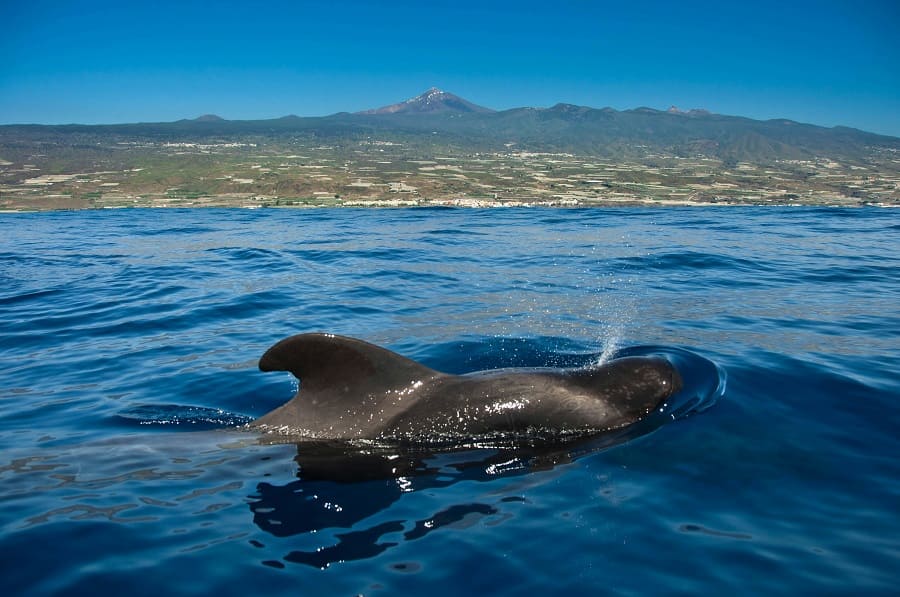
It is one of the most common questions typed into Google by anyone planning a Tenerife holiday: can you actually swim with the whales and dolphins here? The south coast has one of the highest concentrations of resident cetaceans anywhere in Europe, and seeing a sales page with a photo of someone in the water next to a pilot whale makes the idea feel entirely plausible.
The honest answer is no, not with the whales and dolphins themselves. It is illegal in Tenerife waters, for reasons that are worth understanding properly rather than just accepting. But there is a genuine, legitimate version of the experience that gets remarkably close: boat trips that combine a respectful, no-chase whale and dolphin sighting with a stop to swim in open water nearby, sometimes in the very bay the animals were just seen in. This guide explains the legal reality, why the rule exists, and where in south Tenerife you can do the closest thing to it properly.
Swimming directly with wild whales or dolphins is prohibited under Canarian and Spanish marine protection law, enforced with real penalties. No legitimate operator in Tenerife will put you in the water with the animals. What you can do is take a boat trip that sights pilot whales and dolphins respectfully from a distance, then stops separately to let you swim and snorkel in clear open water nearby.
Contents
- Why You Cannot Swim With Wild Whales and Dolphins in Tenerife
- What the Regulations Actually Say
- What You Can Legitimately Do Instead
- The Eco-Yacht Tour With a Swim Stop at the Cave of Love
- What to Expect on the Day
- How to Spot a Genuinely Ethical Operator
- Practical Tips
- Frequently Asked Questions
Why You Cannot Swim With Wild Whales and Dolphins in Tenerife
The waters between Tenerife and La Gomera are home to a resident population of short-finned pilot whales and bottlenose dolphins that live there year-round, which is precisely why the area has such a strong reputation for sightings. It is also exactly why the regulations around approaching them are taken seriously. A resident population that is constantly exposed to boat traffic and tourist activity is at far greater risk of behavioural disruption than a population passing through once.
A person in the water near a wild pilot whale or dolphin changes the animal’s behaviour whether the human intends it or not. Marine biologists describe this as a stress response: the animal may alter its diving pattern, separate a calf from its mother, or simply avoid the area in future. None of this is visible to the swimmer having the experience, which is part of why the practice remains tempting to misinformed operators in some parts of the world, even though it causes a genuine welfare problem.
What the Regulations Actually Say
Whale and dolphin watching in the waters around Tenerife is governed by specific regulations designed to protect the resident population. The rules are consistent across operators and are enforced rather than advisory.
| Rule | Requirement |
|---|---|
| Minimum distance | At least 60 metres from any whale or dolphin at all times |
| Maximum observation time | 30 minutes per encounter |
| Boat speed | Slow speeds only, no sudden course changes |
| Swimming, touching, or feeding | Strictly prohibited under all circumstances |
| Disturbed animal protocol | Boats must leave the area immediately if animals show signs of disturbance |
| Waste | No waste of any kind may be thrown into the water |
Reputable whale watching companies in Tenerife sign up to a voluntary Sustainability and Quality Charter that commits them to a respectful, no-chase approach to every sighting. Asking an operator directly whether they hold this charter is a reasonable and fair question before booking.
What You Can Legitimately Do Instead
This is where the genuinely good version of the experience comes in, and it is closer to the original idea than most people expect. A well-run boat trip does two separate things on the same outing: it finds and respectfully observes pilot whales and dolphins from the required distance, and it stops, separately, at a sheltered bay or cove to let passengers get into the open Atlantic water for a swim and a snorkel. The two activities are not combined, because combining them is exactly what the law prevents. But experiencing both within the same couple of hours, on the same stretch of water the animals live in, is entirely legal and is what the better operators in the south specifically offer.
You are still in the same body of water the whales and dolphins inhabit. The swim stops used by these operators are chosen specifically because they are calm, clear, and rich in marine life: sea turtles, rays, and reef fish are commonly seen at the swim stop itself, even when the whales and dolphins are not part of that particular moment. It is a genuinely different, broader experience of the same marine environment rather than a watered-down version of swimming with cetaceans.
The Eco-Yacht Tour With a Swim Stop at the Cave of Love
One of the better examples of this format departs from Los Cristianos harbour aboard the Travelin’ Lady, a purpose-built eco-yacht rather than a converted leisure boat. The distinction matters: a low centre of gravity reduces the seasickness that affects a meaningful number of passengers on standard boats, and the ultra-low emission engine runs quiet and smokeless, which causes noticeably less disturbance to marine life than a standard diesel engine.
The tour follows the format described above. It searches the southern coastline for pilot whales, dolphins, sea turtles, and occasionally fin whales, observing respectfully and without pursuit. It then continues to the Cave of Love, an area of clear, sheltered water, where conditions permitting, the boat stops specifically to let passengers swim and snorkel. Snorkelling equipment and towels are provided. A bar service is available on board for snacks and drinks, and hotel pickup is included.
Tenerife Eco-Yacht Whale and Dolphin Watching Tour With Swim
| Departs From | Fisherman’s Wharf, Zone A, Port of Los Cristianos |
| Boat | Travelin’ Lady, a purpose-built environmentally certified eco-yacht |
| Duration | 1.5 hours |
| Includes | Professional crew, specialist guide, lifejackets, snorkelling equipment, towels, bar service for snacks and drinks, hotel pickup |
| Languages | English, French, Spanish, Italian |
| Booking | Free cancellation up to 24 hours in advance. Reserve now, pay later option available |
| Not Suitable For | Wheelchair users |
“A brilliant morning out. We were lucky enough to see turtles, lots of dolphins and a pod of pilot whales. The guides were informative and friendly. The swim at the end just made the trip even better.” Multiple reviewers from June 2026 specifically mention the combination of a strong sighting and the swim stop as the highlight of the trip.
What to Expect on the Day
Arrive at the port 30 minutes before departure. The boarding gate closes 10 minutes before sailing. The meeting point is Fisherman’s Wharf, Zone A, behind the large green fence, following the blue line painted on the ground. Look for the activity provider’s kiosk (kiosk number 1, staff in red polo shirts) if you have any questions on arrival.
Swimwear, a towel (though one is provided), and sunscreen. Snorkelling equipment is included so there is no need to bring your own.
Like all boat trips of this kind, the swim stop and the sailing itself are subject to sea conditions on the day. If conditions are not suitable, the operator will notify you with as much notice as possible and offer a reschedule or a full refund. This is standard across the industry and not specific to any one operator.
How to Spot a Genuinely Ethical Operator
Not every boat advertising whale watching in south Tenerife operates to the same standard, and a few simple checks separate the genuinely respectful operators from the ones cutting corners.
Does the operator describe a no-chase policy explicitly, rather than just promising sightings? Do they mention the Sustainability and Quality Charter or an equivalent commitment? Is the boat slow and quiet, or does it look built for speed? Genuinely ethical operators are usually proud to talk about their approach distances and observation limits, because it is something they have actively chosen rather than been forced into.
An operator promises you can swim directly with the whales or dolphins, or implies the animals will approach the boat closely on demand. Both claims should be treated as a sign the operator is either being dishonest about what is legal, or genuinely unaware of the regulations, neither of which is reassuring.
Practical Tips
Sea conditions in the south of Tenerife are generally calmer earlier in the day, which means a more comfortable crossing and better visibility for both the sighting and the swim stop.
The swim stop is a separate part of the trip from the sighting, not a continuation of it. Treat the two as different highlights of the same outing rather than expecting the whales to still be visible while you are in the water.
If you are prone to seasickness, a boat specifically designed with a low centre of gravity, as described for the eco-yacht above, genuinely does make a difference compared to a standard leisure boat. Taking a standard seasickness tablet an hour before departure is still sensible regardless.
For the full picture on every whale watching operator in south Tenerife, including the larger catamaran tours and family-friendly options, see our complete guide to whale watching in Tenerife.
Frequently Asked Questions
Can you swim with whales in Tenerife?
No. Swimming directly with wild whales or dolphins is illegal in Tenerife waters under regulations designed to protect the resident population from disturbance. What you can do is take a boat tour that combines a respectful sighting of whales and dolphins with a separate swim and snorkel stop in open water nearby, which is entirely legal and widely available.
Is it illegal to swim with dolphins in Tenerife?
Yes. Touching, feeding, or swimming with wild dolphins or whales is strictly prohibited under the marine protection regulations that govern the waters around Tenerife, with penalties for swimmers and operators who breach them. Reputable operators will never offer this as part of a tour.
What is the Cave of Love in Tenerife?
The Cave of Love is an area of clear, sheltered water off the south coast of Tenerife used by some whale watching operators as a swimming and snorkelling stop. It is a separate part of the tour from the whale and dolphin sighting, offering calm, clear conditions and a chance to see other marine life including turtles and reef fish. This eco-yacht tour from Los Cristianos includes a stop there.
What is an eco-yacht whale watching tour?
An eco-yacht is a purpose-built boat designed specifically for wildlife watching, typically with a low centre of gravity to reduce motion sickness and an ultra-low emission engine that runs quieter than a standard diesel boat, causing less disturbance to marine life. This is different from a converted leisure boat or a large catamaran, and tends to suit smaller groups who want a calmer, more focused experience.
Are pilot whales and dolphins guaranteed on a Tenerife boat trip?
Sighting rates are exceptionally high due to the resident population of pilot whales and bottlenose dolphins in the waters between Tenerife and La Gomera, with most reputable operators reporting sighting rates close to 99 percent across the year. Sightings are never guaranteed on any individual trip, as these are wild animals, but the odds are genuinely strong.
Where do whale watching boats with a swim stop depart from in south Tenerife?
Most depart from either Puerto Colón in Costa Adeje or Los Cristianos harbour. The eco-yacht tour covered in this guide departs from Los Cristianos. For a wider comparison of departure points and operators, see our complete whale watching guide.
Marine wildlife sightings cannot be guaranteed on any tour. Swim stops are subject to weather and sea conditions on the day and may be cancelled or rescheduled by the operator for safety reasons. Always check current booking terms and cancellation policies directly before travelling.