This guide contains affiliate links. If you book a tour through them we earn a small commission at no extra cost to you, and we only link tours we would point a friend towards.
Most people ride the cable car up Teide, take a photo, and ride back down. That is the version of the mountain most guides describe, and it skips the two times Teide is actually worth the drive: when the sun is going down, and after it has gone. By day it is a 3,715-metre volcano sitting in terrain so like Mars that space agencies have used it to test rover equipment. By night it sits under one of the darkest, clearest skies anywhere on Earth. This covers both, whether you drive yourself, take the cable car, or ride up on a quad.
Contents
- What Teide actually is
- Getting there from the south
- The cable car and the summit permit
- Seeing Teide by quad
- Teide at sunset: the shadow and the sea of clouds
- Teide by night: one of the darkest skies in the world
- What to wear and take
- Practical tips
- Frequently asked questions
What Teide actually is
Teide is the highest point in Spain at 3,715 metres, but that figure undersells it. Measured from its base on the Atlantic floor rather than from sea level, it is one of the tallest volcanoes on the planet, rising around 7,500 metres from bottom to top. It is still active, though it last erupted in 1909, and the whole mountain sits inside Las Cañadas, a vast collapsed crater roughly 16km across.
The landscape up there does not look like the rest of Tenerife, or much of the rest of the world. Fields of black and rust-red lava, twisted rock formations like the Roques de García, and pale pumice flats stretch out under a sky that is a deeper blue than at the coast because you are above a third of the atmosphere. The soil is close enough to the Martian surface that space agencies have used the area to test equipment bound for Mars, and the caldera has stood in for alien planets in more than one film. The national park has been a UNESCO World Heritage Site since 2007.
None of that is visible from a hotel pool. Getting up there, in some form, is the point.
Getting there from the south
From the southern resorts you are looking at roughly an hour to an hour and a half by road, climbing from sea level to over 2,000 metres. The usual route from Los Cristianos, Playa de las Américas and Costa Adeje runs up through Chío and Guía de Isora on the TF-38, which meets the TF-21 near the base of the cable car. It is a good road, but it is a long, winding climb with a lot of switchbacks, and the altitude gain is real, so anyone prone to car sickness should sit in the front and go steady.
There is no direct public bus that makes a day trip easy. The 342 runs up from the south once a day and back once in the afternoon, which gives you a fixed and fairly short window at the top. Most people either hire a car, join a coach tour, or take one of the quad tours below. If you would rather not drive at all, our guide to getting around south Tenerife without a car covers the bus options and their limits.
The cable car and the summit permit
The Teleférico del Teide carries you from the base station at 2,356 metres up to La Rambleta at 3,555 metres in about eight minutes. A return ticket is around €40 for a non-resident adult, roughly €20 for a child, and you book a timed slot online at the official site, volcanoteide.com. Book ahead. It sells out days in advance in busy periods, and turning up on spec often means being turned away or facing a long wait, since coach groups get priority slots.
Here is the catch most people do not realise until they are at the top. The cable car does not take you to the summit. From La Rambleta you can walk two short trails to viewpoints, La Fortaleza looking north and Pico Viejo looking over a huge second crater, with no permit needed. But the final 160 metres up to the actual 3,715-metre peak, on the Telesforo Bravo trail, requires a free permit booked well in advance.
That permit system tightened in 2026. You now book it through the official TenerifeON platform, slots are limited and released in batches, there is a new access fee for parts of the park, and the summit slots go quickly in season. If standing on the very top matters to you, sort the permit before you book anything else, because you cannot get one on the day. Plenty of people are perfectly happy with the cable car and the free viewpoints, which give you the views without the admin.
Seeing Teide by quad
If the cable car and a coach feels a bit passive, the other way up is on a quad. A guided quad tour trades the summit for the journey: you ride the mountain roads through the volcanic terrain, stopping at viewpoints, with the wind and the altitude and the scenery doing the work a coach window cannot. It is the option most people who want a bit of adventure end up choosing, and both of the tours below run from the Chío side, about 40 minutes from the southern resorts.
One point on terms first. These are quads, four-wheeled bikes you drive yourself, sometimes listed as ATVs on the booking sites. You drive, a guide leads the group, and no experience is needed beyond a driving licence and the confidence to ride on a road.
Two tours are worth knowing about, and they suit different people.
The first is Fun Teide Quad’s sunset or morning tour, which is the higher rated of the two at 4.8 from nearly 300 reviews, a lot of them recent British and Irish bookings. It runs about three hours, includes helmet and gloves, and you can pick a morning ride or the sunset slot. Pricing is per person, from around €100, and it uses double quads, so two people share one machine. The one thing to get right: you must bring a physical driving licence, not a photo of it, or you will be refused, and non-EU visitors need an International Driving Permit alongside it. Drivers must be 18 or over.
The second is Quadhub’s three-hour guided tour, rated 4.6 from nearly 500 reviews. It is priced per quad rather than per person, from around €125, and that is the same whether you ride solo or take a passenger, so for a couple it works out cheaper. It also includes more: a thermal jacket, full-face helmet and gloves, plus snacks and drinks, and it will arrange hotel pick-up from Los Cristianos through to Playa Paraíso if you ask after booking. There are four departure times including a 19:00 sunset run, the route takes in named viewpoints like the Mirador de Samara, and reviewers repeatedly note there is no hard-sell on upgrades, with the photos, insurance and second-driver option all genuinely optional.
Between them: pick Fun Teide Quad if you want the top-rated operator and do not mind arranging your own way to the meeting point, or Quadhub if you are a couple, want the transfer and the warm jacket included, and like the flexibility on times. Both require closed-toe shoes, both provide helmets, and neither allows flip-flops or sandals. And for either one, if you can, choose the sunset departure, for the reason in the next section.
Teide at sunset: the shadow and the sea of clouds
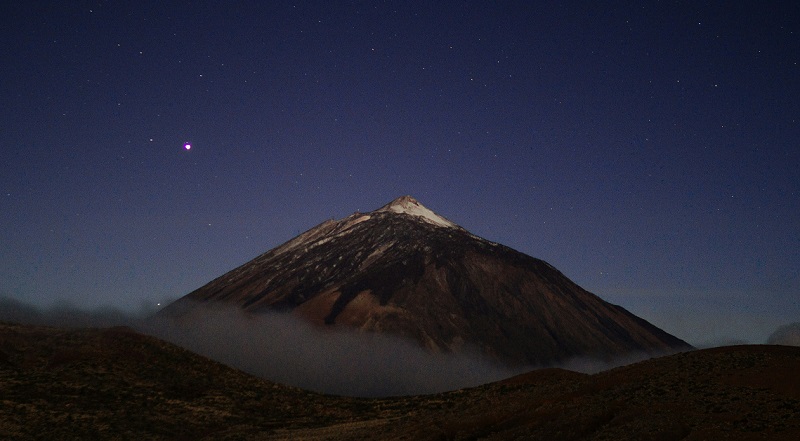
Sunset is when Teide does something you will not see written on the ticket. Because the popular viewpoints sit around 2,000 to 2,200 metres, you are usually above the trade-wind cloud layer, the mar de nubes, the sea of clouds that so often hides the coast below. From up here that cloud becomes a floor rather than a ceiling, and the sun sets into it rather than behind buildings.
As the sun drops, the mountain throws a vast triangular shadow across the sky and the cloud to the east. The odd part is that the shadow is a near-perfect pyramid even though Teide itself is not, a trick of perspective and atmosphere that catches people off guard every time. The low light turns the lava fields deep amber and red, the colours the volcanic rock is named for, and the temperature drops fast once the sun is gone.
You do not need a tour to see it. Any of the miradores along the TF-21 works, and if you are driving yourself you can simply park up and wait. But the sunset quad run has an obvious appeal, riding back down through the fading light with the island spread out below, and it is the reason several reviewers single out the evening slot over the morning one. For other spots to catch the light closer to the coast, our guide to where to watch the sunset in south Tenerife covers the seafront options.
Teide by night: one of the darkest skies in the world
Stay after dark and Teide changes job entirely. Along with sites in Chile and Hawaii, it is considered one of the three best places on the planet for observing the night sky, and that is not marketing. It comes down to a few things stacking up.
The park sits above 2,000 metres, over the cloud and haze that blur the view lower down, in dry, stable air. Tenerife has protected its skies since 1988 with the Ley del Cielo, the Sky Law, which limits light pollution, controls the direction of streetlights, and even routes aircraft away from the area. The result is a sky rated Bortle class 2 to 3, the same darkness as a professional observatory site, on more than 300 clear nights a year. From up here you can see 83 of the 88 recognised constellations, and the Milky Way is not the faint smudge you might know from a British garden but a bright, structured band across the whole sky.
There is real science behind it, not just tourism. The Teide Observatory at Izaña, at around 2,400 metres, is run by the Instituto de Astrofísica de Canarias and holds telescopes belonging to institutions from around 20 countries. It runs daytime tours if you want to see the working instruments, though you cannot use them yourself.
For actually seeing the stars, the guided stargazing tours are the easy way in. They run from around €35, use Starlight-certified guides who point out constellations and planets with a laser and set up a telescope for a proper look at Saturn’s rings or Jupiter’s moons, and most include a photo of you under the stars taken with a long exposure. If you want to try it alone, bring warm clothes, a red torch to keep your night vision, and aim for a night near the new Moon, when the sky is at its darkest. If you are timing a visit, the Perseid meteor shower peaks in mid-August and the Geminids in mid-December, and both are worth planning a night around from up here. Our stargazing guide goes into the tours, the timing and the best spots in more detail.
One honest caveat. All of this depends on a clear, moonless night, and on the Saharan dust haze known as the calima staying away, which it does not always. Check the forecast, and do not pin the whole thing on your last evening with no room to move it.
What to wear and take
This is where Teide catches people out more than anything else. It can be 25 degrees on the beach and close to freezing at the top, and colder still after dark, with a wind that makes it feel harsher. In winter there is often snow, and the cable car closes when the wind is high.
You do not need mountaineering kit, but you do need layers. A warm top and a windproof jacket, long trousers, and closed shoes rather than sandals, since the ground is loose volcanic rock. For an evening or a stargazing session, add a hat and gloves even in summer, because you will be standing still in the cold for an hour or more. The guided quad tours provide a jacket and helmet, but a warm layer underneath is still worth having.
Two things people forget. The sun is stronger at altitude, so sun cream and sunglasses matter even when it feels cool. And there is no water and little shelter up there, so take a bottle and some food with you.
Practical tips
- Book the cable car online in advance at volcanoteide.com. It sells out, and there is no fast track for turning up on the day.
- For the actual summit, book the free Telesforo Bravo permit through TenerifeON well ahead. You cannot get one on arrival.
- For a quad tour, bring a physical driving licence, not a photo, and an International Driving Permit if you are from outside the EU.
- Choose the sunset slot over the morning one if you can, for the light, the sea of clouds and the shadow.
- Take warm layers whatever the coast is doing. Near-freezing at the top is normal, even in August.
- For stargazing, aim for a night near the new Moon and check there is no calima forecast.
- Fill up with fuel before you start the climb. Petrol stations are scarce once you are on the mountain.
- Don’t leave Teide for your last day. Weather, wind and dust can all close it, so give yourself a spare day to move it to.
Frequently asked questions
How do you get to Mount Teide from the south of Tenerife?
It is about an hour to 90 minutes by road from Los Cristianos, Las Américas and Costa Adeje, up the TF-38 through Chío. There is one daily bus, the 342, but most people hire a car, join a coach tour, or take a quad tour, which handles the transport for you.
Do you need a permit to go up Teide?
Only for the final climb to the 3,715-metre summit, on the Telesforo Bravo trail, which needs a free permit booked in advance through TenerifeON. The cable car and its two viewpoint trails need no permit, just a cable car ticket.
How much is the Teide cable car?
Around €40 return for a non-resident adult and about €20 for a child, booked as a timed slot at volcanoteide.com. It regularly sells out, so book ahead rather than on the day.
Do you need a licence to drive a quad on the Teide tours?
Yes. Drivers must be 18 or over with a valid physical driving licence, not a photo of one, and visitors from outside the EU need an International Driving Permit as well. No riding experience is required, and helmets are provided.
Is Teide good for stargazing?
It is one of the best places in the world for it, alongside Chile and Hawaii. High altitude above the cloud, a 1988 law protecting the sky from light pollution, and more than 300 clear nights a year give it skies as dark as a professional observatory. Guided tours start from around €35.
Is it cold at the top of Teide?
Yes, much colder than the coast. It can be close to freezing at the summit even in summer, with snow in winter, so warm layers and closed shoes are needed whatever the beach temperature is.
Can you see the sunset and stars on the same trip?
Yes, and it is the best way to do it. A sunset quad tour or an evening stargazing trip lets you watch the sun set into the sea of clouds and then see the sky darken. Book the evening or sunset slot rather than the morning one.
Prices, opening hours, permit rules and tour details change, and the cable car and tours can close at short notice for weather. Always check directly with the cable car, the tour operator or the official park site before setting out, especially for a specific date or a stargazing night.