
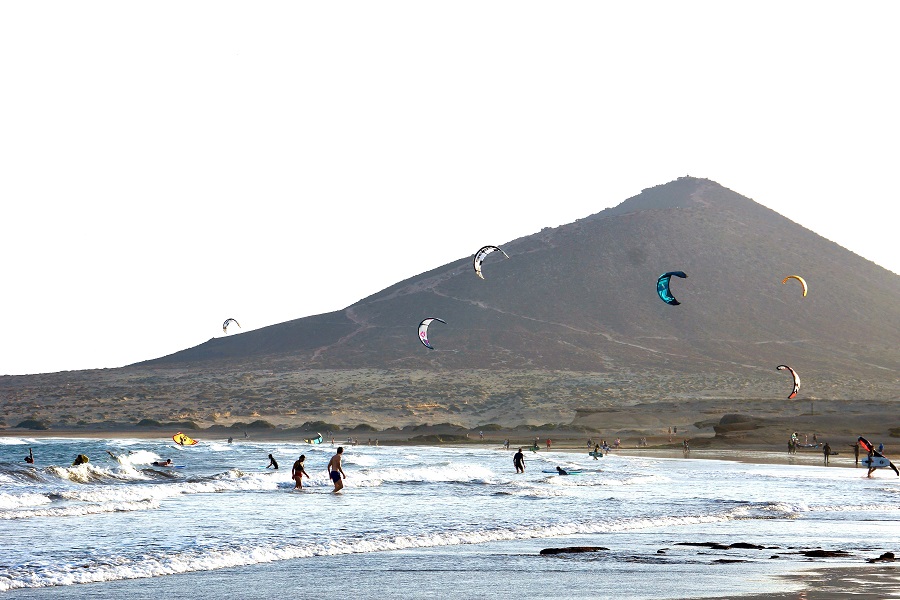
El Médano is what south Tenerife looked like before the resorts arrived. It is a small, wind-blown town on the southeast coast, ten minutes from the airport, where the beaches are natural rather than imported, the buildings stay low, and the loudest thing on the seafront is usually the wind. There is no line of identical hotels along a promenade and no strip of matching bars. Instead there are kitesurfers, a red volcano, and a slow, slightly bohemian pace the package resorts lost a long time ago.
To understand the place you have to understand the wind, because the wind is both why people love it and why some people leave disappointed. The steady 20 to 25 knot trade winds that made El Médano one of the best windsurfing spots in the world also made it useless for the sunbed-and-cocktail model, so it never got built up the way Las Américas did. If you come expecting a sheltered sunbathing resort, the wind will annoy you. If you come for the beaches, the walking, the sport and the character, it is one of the most rewarding corners of the island.
Contents
- What makes El Médano different
- Getting there
- The beaches
- The wind, and trying the watersports
- Climbing Montaña Roja
- Eating and the town
- When to go, and who it suits
- Practical tips
- Frequently asked questions
What makes El Médano different
Most of the southern resorts follow the same formula: a sheltered man-made beach, a row of big hotels, a shopping centre and a nightlife strip. El Médano did not develop that way. The constant wind pushed it towards windsurfing, kitesurfing, surfing and beach life instead of mass tourism, and the result is a town that feels local and independent rather than packaged.
That shows in small ways. The beaches are the natural coastline rather than sand shipped in behind a breakwater. The cafes are run by people who live there and half of them are aimed at a surf and yoga crowd. The dress code is boardshorts and salt-dried hair, not resort-wear. It is the sort of place that explains the real south of the island better than another hotel promenade can, and it is a useful antidote if the resort strip starts to feel same-y.
Getting there
El Médano sits in the municipality of Granadilla de Abona, roughly 7km and about ten minutes from Tenerife South Airport, and 20 to 25 minutes from Los Cristianos and Playa de las Américas. That airport proximity is worth planning around. It makes El Médano an ideal first or last day of a holiday, somewhere to spend the hours before a late flight without trekking back to a resort, and a short taxi from arrivals.
You do not need a car once you are there, since the town is walkable and everything is close. Regular TITSA buses connect it to the resorts and the airport, and a local service runs out to the quieter beaches. If you are weighing up whether to hire a car at all for your trip, our guide to getting around south Tenerife without a car covers the bus network. A car does help for reaching La Tejita and Montaña Pelada with beach kit, though, so it is the one part of an El Médano visit where your own wheels earn their keep.
For the wider arrival logistics, including the new fingerprint checks at passport control, see our Tenerife South airport guide.
The beaches
The beaches are the reason to come, and they range from a fully serviced town beach to genuinely wild coastline. They also sit on natural grey and golden sand rather than the imported gold of the resort beaches, which some people love and others find takes getting used to.
Playa de El Médano is the main town beach, with fine sand, restaurants, toilets, showers, sunbed and umbrella hire and a tourist office, backed by the promenade. It is family-friendly near the town and gets sportier towards the open end, where the kitesurfers gather. This is your everyday beach.
Playa de la Tejita is the one to make the effort for. It stretches around a kilometre beyond Montaña Roja and is one of the largest natural beaches on the island, wild and undeveloped, with a naturist section at the far end near the mountain. There are no facilities at all, so bring water, food and shade. You can drive and park at the Playa La Tejita exit off the TF-1, or walk the coastal path from the western end of El Médano beach.
El Cabezo, just up the coast, is the serious watersports beach, better for watching the advanced kitesurfers and wave riders than for a lazy afternoon. Playa de la Jaquita is the opposite, a small Blue Flag beach that is compact, clean and calmer than the rest. And Montaña Pelada, a couple of kilometres out and reachable on the local bus, is an unspoiled naturist beach with sandstone rock that glows yellow at sunrise and sunset, again with no facilities and no lifeguard, so take care in the water.
For how these compare with the resort beaches further west, see our guide to the best beaches in south Tenerife.
The wind, and trying the watersports
El Médano is one of the best places in the world to learn to windsurf or kitesurf, and the reason is the wind’s reliability. The trade winds blow across a range of conditions here that suit every level, from flat, protected water for beginners to the waves at El Cabezo for the experienced, and the wind typically picks up around midday and holds into a sunset session. It hosts World Championship windsurfing and kitesurfing events for good reason.
Even if you have never tried it, a beginner lesson is one of the best things you can do here, and it is the activity the town is built around. A first kitesurf lesson usually starts with kite control on the sand before you go anywhere near the water, and a good school will only take you out when the conditions are right for learning. If you are not sure which sport suits you, some schools run a taster that lets you try windsurf, kite, wing foil and surf in a single session, which is the sensible way to find out before committing to a course. You can book a beginner watersports lesson in El Médano here, with the gear and instruction included.
Two honest pointers. Book your lesson early in your holiday, not the last day, because wind sports depend on the weather and a session can be moved if the conditions are wrong, so you want spare days to reschedule into. And if you would rather stay dry, El Médano is a fine place simply to sit with a coffee and watch the kites, which is a proper spectacle in a strong wind. For calmer paddling, several schools also rent stand-up paddleboards for the sheltered mornings. If surfing specifically is your thing, our surf lessons guide covers the wider south coast options.
Ten to fifteen minutes down the coast, the marine reserve at Abades is the pick for snorkelling on this side of the island, which pairs well with an El Médano day. Our snorkelling guide covers it, including a guided tour with hotel pickup.
Climbing Montaña Roja
The red volcanic cone between El Médano and La Tejita is not just scenery. Montaña Roja is a 171-metre protected nature reserve, and you can walk up it for one of the best coastal views in the south, out over both beaches and the wind-flecked sea.
It is a short climb rather than a hike, but do not underestimate it. There is no shade, the ground is loose in places, and the same wind that draws the kitesurfers makes the exposed top cold and blustery even on a warm day. Take water, sun protection and proper footwear rather than flip-flops, keep to the marked paths since it is a protected area, and it is at its best early or late when the light is soft and the heat has dropped. Sunrise and sunset from here are genuinely worth the early alarm, and our guide to where to watch the sunset in south Tenerife has more spots if you want to build an evening around it.
Eating and the town
The food scene matches the town: casual, independent and a world away from the resort menus. The promenade and the streets behind it are lined with cafes, brunch spots and beach bars aimed at a mix of locals, long-stay surfers and visitors, so you eat well without the tourist-menu feel. Expect good coffee, fresh and often vegetarian-friendly plates, and chiringuitos, the informal beach bars, where a cold drink and a view of Montaña Roja is the whole point.
For a proper dinner, the fishing village of Los Abrigos is a five-minute drive along the coast and is where the seafood is, with a harbour front of fish restaurants serving the daily catch. It makes a natural pairing: a windy afternoon in El Médano, then a calm seafood evening in Los Abrigos. There is also a weekend market in El Médano worth timing a visit around for local produce and crafts.
When to go, and who it suits
El Médano is a year-round destination with a mild winter, daytime air around 22 to 24°C even in the colder months, and sea temperatures of roughly 18 to 20°C in winter climbing above 21°C in summer. The wind blows all year, which is the point for watersports and the catch for everything else.
Be honest with yourself about what you want. If your ideal holiday is lying still on a sheltered beach all day, the wind will frustrate you, and one of the resort beaches further west will suit you better. If you want beaches with character, a town with a pulse of its own, world-class conditions to learn a sport, and somewhere that feels like the real island rather than a holiday complex, El Médano is hard to beat. Families do well here too, with the calmer town beach and the space of La Tejita, as long as everyone is happy with a bit of wind and sand.
One weather note specific to this coast: during a calima, the Saharan dust haze, the wind can carry a lot of grit, so check the forecast before a beach day.
Practical tips
- Mornings are the calm window. The wind usually gets up around midday, so if you want a still beach or a flat-water paddle, go early.
- Book any watersports lesson early in your holiday, since wind conditions can force a session to be moved and you want spare days to reschedule.
- Bring supplies for the wild beaches. La Tejita and Montaña Pelada have no shops, cafes, toilets or lifeguards, so take water, food and shade.
- A car helps for La Tejita and Montaña Pelada with beach kit, even though the town itself needs none.
- El Médano is ten minutes from the airport, which makes it an excellent first or last day rather than doubling back to a resort.
- Pack a light layer. Evenings and the top of Montaña Roja are cooler and windier than the beach.
- Two of the wild beaches have naturist sections, at La Tejita and Montaña Pelada, which is worth knowing if you are visiting with children.
Frequently asked questions
Where is El Médano and how do I get there?
It is on the southeast coast, about ten minutes from Tenerife South Airport and 20 to 25 minutes from Los Cristianos and Playa de las Américas. Regular buses connect it to the resorts and the airport, and the town itself is walkable.
Is El Médano good for a beach holiday?
It depends what you want. The beaches are natural and characterful, but it is windy, which suits watersports, walking and beach culture more than still sunbathing. For a sheltered sunbed day, the resort beaches further west are better.
Why is El Médano so windy?
Steady trade winds funnel across this stretch of coast, typically 20 to 25 knots, usually strengthening around midday. That wind is exactly why it became a world-class windsurfing and kitesurfing spot rather than a conventional resort.
Can beginners learn to kitesurf or windsurf there?
Yes, it is one of the best places to learn, with a range of conditions and several established schools. Beginner lessons start with control on the sand before the water. Book early in your holiday so there is room to move the session if the wind is wrong.
Is Montaña Roja worth climbing?
Yes, for the coastal views over both beaches, and it is a short climb rather than a hike. Take water, sun protection and proper shoes, keep to the paths as it is a protected reserve, and go early or late to avoid the heat.
Where should I eat near El Médano?
The town has casual cafes, brunch spots and beach chiringuitos. For a seafood dinner, the fishing village of Los Abrigos is a five-minute drive away and is known for its harbour-front fish restaurants.
Are the beaches suitable for families?
The town beach, Playa de El Médano, is family-friendly with full facilities. La Tejita offers space but no facilities. Note that La Tejita and Montaña Pelada both have naturist sections.
Prices, conditions and opening details change, and watersports sessions depend on the weather, so always check directly with schools, restaurants and the current forecast before setting out. Wild beaches have no lifeguards, so take care in the water.
This guide contains an affiliate link to GetYourGuide. If you book through it we earn a small commission at no extra cost to you.